
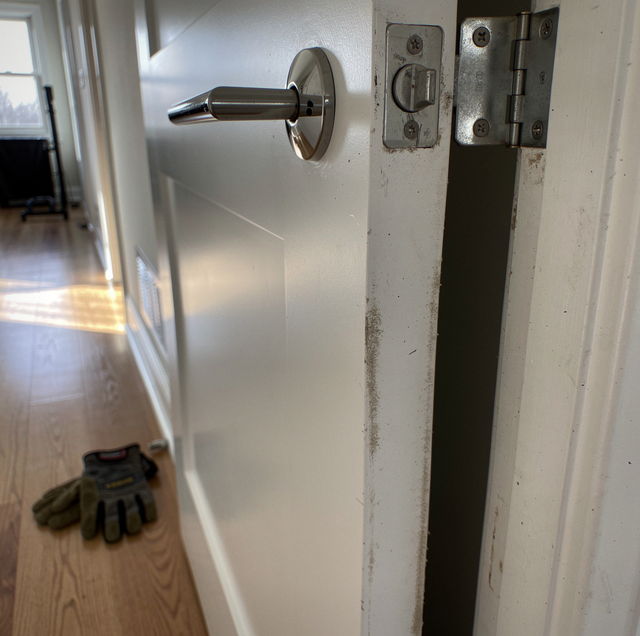
A doorknob and a latch bolt are connected by a short, simple chain, and every part of that chain has exactly one job. The knob's hub grips a square spindle that passes through the door to the handle on the far side. Turning either knob rotates the spindle, which turns a cam or retractor housed in the latch, drawing the bolt in against its spring. Break any single link in that chain and the knob keeps turning while the latch stays exactly where it was, so the door stays shut even though nothing about it is locked. Which side of the knob spins, how freely it turns, and whether the latch bolt moves at all identify the link that gave way.
Each thing the knob does is set against the part that broke and the way back in:
| What the Knob Does | What Broke | How the Door Gets Opened |
|---|---|---|
| Spins freely on both sides, no resistance at all | The spindle sheared or slipped out of both knob hubs | The lockset comes off to reach the latch directly |
| Spins freely on one side while the other still draws the latch | That knob's own connection to the spindle failed, not the spindle itself | The working side still opens the door until the lockset is replaced |
| Turns partway, then stops hard | The retractor or cam inside the latch is jammed or broken | The latch is worked from the door edge or the lockset comes apart |
| Turns fully but the latch bolt only moves a little | A worn retractor no longer pulls the bolt clear | A latch-only replacement is fitted where the lockset is otherwise sound |
| A lever droops and turns without drawing the latch at all | The lever's drive or return spring failed, not the latch | The lever is reset or replaced without touching the latch body |
How a Knob Moves a Latch
Turning a knob does one mechanical job: it rotates a square spindle that runs straight through the door to the knob or lever on the other side, and that spindle turns a small retractor, or cam, mounted inside the latch body. The retractor pulls the latch bolt back against a coil spring as it turns, clearing the bolt from the strike plate in the frame so the door swings free. Let go of the knob, and the spring pushes the bolt back out on its own, ready to catch the strike plate again the next time the door closes. A lever handle operates the same retractor and spindle, with its own return spring to swing the lever back to level once released. On a cylindrical-bored lockset, all of this sits in a chassis dropped through two round holes drilled in the door face and edge; on an older door built with a mortise lock, the same retractor-and-spindle connection sits inside a single case let into the door's edge instead.
Reading Which Side Spins
If both knobs turn with no resistance at all, front and back, the spindle itself has separated from one or both hubs, and neither side has any mechanical connection left to the latch. If only one side spins loosely while the other still turns with the familiar light resistance of a spring pulling back, that single knob's grip on the spindle can fail at a stripped or loose set screw inside its hub, while the spindle and the latch on the working side stay untouched. A worn key cylinder that spins in its housing without ever turning the bolt is a related but separate symptom, tied to the key side of a different kind of lock rather than to the knob's spindle connection. Push and pull the door gently while turning each knob in turn, without forcing anything, to feel which side still meets resistance and which one spins with nothing behind it.
When the Latch Itself Has Failed
A knob that turns against its own spring while the bolt stays put moves the fault past the spindle to the latch body. The retractor inside can crack or shear off its mount, so the knob's motion no longer reaches the bolt, and the bolt stays at full extension in the strike. A latch whose spring has weakened is a different fault: the bolt may not spring fully out, so the door does not stay latched. A privacy lock on a bathroom or bedroom door that will not release from outside is a locking fault in the knob rather than a broken link, and it has its own fixes.
How a Locksmith Gets the Door Open Without Wrecking It
Once the failure is within the mechanism rather than a missing key, the aim is to reach the latch without causing additional damage to the knob, door, or frame. A thin, flat tool worked through the gap at the door edge can push a spring latch bolt back directly, bypassing a broken knob or spindle where the latch is reachable at the edge. Where the working side of the knob is still connected, removing that side's rose and knob gives direct access to the spindle and retractor without disturbing the door itself. On a lockset too damaged to save, the whole assembly comes out of the door, and a new one goes in, which also settles the repair. None of these approaches promises that the door will open without any marks at all; damage-free entry is the goal each one is built around. A key stub broken off in a cylinder is an unrelated repair with its own fix. Losing every key to the house is its own kind of lockout, unrelated to a knob that spins with a good key still in hand. Prying at the jamb, kicking the door, drilling the lock, or removing the hinge pins on an exterior door do not solve a broken spindle or retractor; they damage the frame or the door while leaving the real failure untouched.
When a child, an older adult, or anyone unwell is shut inside a room, emergency services are called first, not force applied to the door. Forcing the spindle with pliers breaks the remaining parts; a locksmith works the latch free instead.
Repair or Replace
A broken latch is not always a broken lockset. When the retractor or the spring inside the latch body has failed, but the knob, spindle, and outer trim are otherwise sound, a latch-only replacement, matched to the same backset and faceplate size, restores the door without touching anything else. When the spindle has sheared, a knob hub has cracked, or the whole assembly carries the same wear that caused the break, the entire lockset is replaced, and a new lockset on an exterior door can be keyed to match the house's existing key rather than adding one more key to the ring.
Why a Knob Loosens Before It Fails
Loose mounting or set screws let a knob's hub shift slightly on the spindle each time it turns, and that shift can wear the connection further until it lets go completely. A lever handle carries an added risk: its return spring must snap back to level after every press, and a weakening spring lets the lever droop instead of springing back, which is a sign the spring, not the latch, is failing.
Frequently Asked Questions
On a knob held by a set screw, sometimes: where the screw has only backed off, and the spindle's square corners are still sharp, the knob is re-seated, and the screw tightened. A spindle whose corners have rounded is replaced, since no hub can grip it again.
A sudden onset has a mechanical cause: a set screw finishing its slow retreat, or a partly cracked spindle finally separating. The spindle and retractor are metal, so temperature and humidity swings that move a wood door in its frame do not act on them the same way.
On an interior knob whose mounting screws are visible on the rose, the knob can come off without damaging the parts. A set with no screws showing on the rose hides its release, and that set is left to the locksmith. Forcing a knob that will not budge turns a spindle problem into a cracked knob or a bent spindle on top of the original failure.
On a door with a separate deadbolt, no. The deadbolt's own cam and tailpiece move only the deadbolt, sharing nothing with the knob's spindle or retractor, so a deadbolt can turn like new next to a knob that spins uselessly, or the reverse. On an interconnected entry set, where the inside lever also retracts the deadbolt, a failure in that shared inside trim can reach both.
It depends on how the retractor is built into that particular latch. Some latch units have the retractor riveted to the cam as a single stamped piece, so a broken retractor there means the whole latch unit needs replacing even though the knob and lockset are fine. On some latches, the retractor is a separate spring-loaded part that can be swapped on its own inside the same latch body.
Yes. A lever turns the same spindle a knob does, but its length multiplies any push on it, so a bag hung on a lever or someone leaning on one loads the spindle and hub in a way a round knob is spared.
Engage lockout service for a doorknob that spins without opening the door — door opening, latch or lockset repair or replacement, and keying to match the house's other locks where needed. Lock Star Locksmith serves Pittsburgh, Bethel Park, and Penn Hills. Call (412) 376-6706.
