
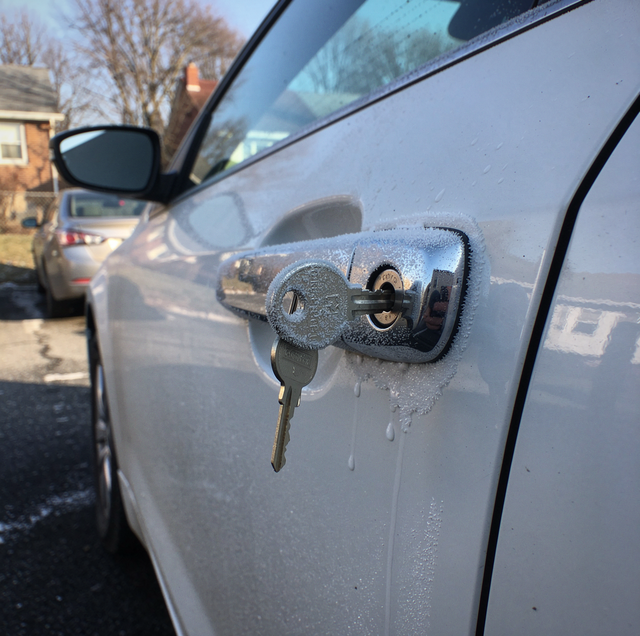
Quick Answer: Cold weather affects locks and ignitions in three ways: trapped moisture freezes into ice inside the cylinder, metal parts contract and tighten the tolerances the pins depend on, and lubricant thickens until it barely moves at all. The result is a key that won't turn, a bolt that drags, or an ignition that resists every attempt to start the car. Gentle warming and dry lubricant solve some cases. A lock or ignition that stays stuck, or one that shows signs of internal wear, needs a locksmith rather than more force.
The first hard-freeze morning of the season has a way of exposing every lock and ignition that was already a little worn. A deadbolt that turned fine all fall suddenly needs a shove. A car that started without complaint yesterday won't take the key today. None of this is bad luck. Cold weather changes the physical conditions inside a lock cylinder in ways that are easy to predict once you understand what's actually happening to the metal, the moisture, and the lubricant packed inside a mechanism that's smaller than a roll of coins.
Why Cold Weather Puts Extra Strain on Locks and Ignitions
A pin tumbler cylinder, the type used in most deadbolts, doorknobs, and ignition switches, relies on tight tolerances. A set of small pins has to line up at precise heights when the right key goes in, and the plug has to rotate freely once that alignment is correct. Those tolerances are measured in fractions of a millimeter even at room temperature, which means there's very little room to spare before something binds.
Cold changes three things that all push those tolerances in the wrong direction at once. Metal contracts as it loses heat, which shrinks the plug, the housing, and the pins by a small but real amount. Any moisture sitting inside the mechanism can freeze into ice, and ice takes up more space than the water it came from. Lubricant, especially anything oil-based, thickens as the temperature drops, turning a coating that was helping the pins glide into a drag that slows them down. Any one of these changes alone might not be noticeable. Together, on a lock that already has some wear or a little built-up grime, they're often enough to turn smooth operation into a fight.
How Moisture Turns Into Ice Inside a Cylinder
Water gets into a lock cylinder more easily than most people expect. Rain and snow work past the edges of a keyway during a storm. Condensation forms inside a car door or ignition housing when temperatures swing between day and night. Humidity in the air settles as tiny droplets on cold metal surfaces overnight. Once that moisture is inside the mechanism, it sits among the pins and springs until the temperature drops far enough for it to freeze.
Ice inside a keyway physically blocks the key from going all the way in, or it locks the pins in whatever position they happened to be in when the water froze around them. That's why a lock can turn perfectly one evening and refuse the same key entirely the next frigid morning: nothing about the key changed, but the water trapped inside the cylinder solidified overnight and wedged the moving parts in place.
Car door locks and ignitions face this problem more often than house locks because vehicles sit outside, exposed to the weather all night, and the metal of a car body loses heat faster than a wooden or masonry doorframe retains it. A key that won't turn in a car ignition on a cold morning, when it turned fine the day before, points more often to ice than to a sudden mechanical failure.
What a Freezing or Stiffening Lock Feels Like
The symptoms of cold-affected locks follow a fairly consistent pattern from one household to the next. A key that used to slide in smoothly now catches partway or won't seat all the way. Turning the key takes noticeably more effort than it did a week earlier, and the resistance shows up specifically during a cold stretch rather than gradually over months. A deadbolt that used to throw with two fingers now needs a fist, or it stops partway through its travel and refuses to seat.
In some cases the key goes in fine but won't turn at all, which usually points to ice rather than wear, since a worn cylinder tends to make the key stick going in as well as coming out. A lock that works normally indoors after being brought up to room temperature, but resists the same key when the door has been exposed to overnight cold, indicates a temperature-dependent problem rather than a permanent one. That distinction matters because it tells you the mechanism itself may be fine, just fighting the cold rather than genuine wear.
Cold-Weather Symptoms Specific to Car Ignitions
An ignition switch works on the same pin tumbler principle as a door lock, but it carries extra strain in cold weather because it also has to turn against a steering column lock and, once the engine catches, against the load of getting a cold engine's oil moving. A key that turns partway and then stops, a key that requires noticeably firmer pressure than usual, or an ignition that accepts the key but won't rotate to the start position at all are all common cold-weather complaints.
Some drivers notice the ignition feels fine on the first attempt of the morning but progressively stiffer on repeat attempts, which points toward thickened lubricant inside the switch rather than ice, since ice tends to either block the key completely or release all at once, rather than getting incrementally worse with each attempt. Either cause responds to the same cautious approach: gentle warming and patience rather than force.
What Not to Do When a Lock or Ignition Won't Cooperate
The instinct to push harder is understandable, and it's also the surest way to turn a temporary cold-weather problem into a broken key or a damaged cylinder. Extra force on a key that's already meeting resistance raises the odds that the key snaps off inside the mechanism, and a snapped key inside a frozen cylinder is a far more involved repair than the stiff lock you started with.
Pouring hot water on a frozen lock or ignition seems like a quick fix, and it rarely is. The sudden temperature swing can crack a cold metal cylinder outright, and the water that doesn't immediately evaporate simply refreezes minutes later, often trapping the key inside the mechanism. An open flame or a lighter held directly against the lock housing carries its own risks to paint, weatherstripping, and nearby plastic trim, and it heats unevenly, which can warp small internal parts.
Household oil, cooking spray, and general-purpose penetrating lubricant all make a cold-weather sticking problem worse rather than better. These products thicken even further as the temperature drops, and the ones that stay somewhat fluid in the cold tend to attract dust and grit that packs into the pins once the weather warms back up. What feels like a fix in the moment often leaves the lock stickier for the rest of the season.
Safe Steps to Try Before Calling for Help
Warming the key itself is one of the safer first moves. Holding the key in a closed fist for a minute, or warming it briefly with a lighter held against the metal (not the lock), lets you carry a small amount of heat directly to the pins when you insert it, which can be enough to melt a thin layer of ice without shocking the whole cylinder the way hot water does.
A lock-rated de-icer, sold in small squeeze bottles specifically for this purpose, is designed to melt ice in a keyway without leaving residue that attracts dirt. It's a different product from general de-icing spray meant for windshields, so check the label before buying one. Working the key gently in and out, without forcing a turn, helps distribute warmth and de-icer through the pins rather than concentrating it at the keyway tip.
Once a lock is thawed and turning again, a dry, PTFE-based lock lubricant applied before the next cold stretch helps prevent the same moisture from settling in and refreezing. Avoid anything oil-based for this purpose. On a car, running the engine for a few minutes with the heater directed at the door can sometimes help a stubborn door lock or handle that's frozen shut, separate from the ignition itself.
When Cold Weather Exposes a Problem That Was Already There
A lock or ignition that only struggles during the coldest weeks and works fine the rest of the year is often marginal rather than fully failing: it has some wear, some built-up grime, or slightly worn pins, and the added contraction and stiffened lubricant of cold weather is just enough to push it over the edge into noticeable resistance. That pattern is worth paying attention to because the same wear that shows up as mild stiffness during one cold snap tends to worsen the following winter if nothing changes in between.
An ignition that's been getting progressively harder to turn over several seasons, even outside of cold weather, usually has wear in the tumbler or the internal contacts rather than a temperature problem alone. Cold weather in that case isn't causing the issue so much as revealing how close the mechanism already was to failing outright. The same goes for a deadbolt that's needed a little extra force for a year or two before this season's cold made it noticeably worse.
When to Call a Locksmith Instead of Continuing to Force It
Call for help if a key won't turn after gentle warming and a lock-rated de-icer, if a key feels close to bending or snapping under normal pressure, or if an ignition won't reach the start position no matter how carefully you work the key. Any lock that's frozen shut with the door or car already needed for the day is also worth a call rather than continued attempts, since repeated tries with a stuck mechanism raise the odds of the key breaking off partway through.
A locksmith can diagnose whether the resistance is ice, thickened lubricant, or genuine mechanical wear, and can extract a key that's already partially broken without damaging the cylinder further. For an ignition specifically, a technician who handles automotive work can service or rebuild the switch itself, which is a different job from anything done on a house door and typically requires specialized tools to access safely. If the same lock or ignition gives you trouble every cold season, having it serviced or replaced before winter starts is usually less disruptive than dealing with it during a cold snap when you need the door or the car working right away.
Frequently Asked Questions
An ignition switch sits deeper inside the vehicle and often traps residual moisture from condensation around the steering column, while door locks are more exposed to open air and dry out faster between uses. The two mechanisms also see different amounts of daily use, and a switch that's turned once or twice a day has fewer chances to work moisture back out than a door handle used constantly.
Usually not. Ice inside a cylinder typically melts on its own once temperatures rise, without leaving lasting damage, as long as no one forces the key while it's frozen. The bigger risk comes from repeated forceful attempts to turn a stuck key, not from the ice itself sitting there overnight.
Yes, and it's one of the clearest signs the problem is temperature-related rather than a worn cylinder. A lock that behaves differently depending on which side of an exterior door it's mounted on, or how long it's been exposed to outdoor air, is responding to cold and moisture rather than to genuine internal wear.
It can help meaningfully, since keeping a vehicle a few degrees warmer overnight slows both metal contraction and lubricant thickening, and reduces the chance of condensation forming overnight in the first place. It won't eliminate the problem if moisture is already trapped inside the mechanism from an earlier storm.
A spare key itself doesn't wear from sitting still, but the lock it fits can still develop the same cold-weather stiffness whether or not that particular key has been used recently. Testing a spare occasionally during the cold months is a reasonable way to confirm that the lock, not just the key, is still working as it should.
The electronic parts of a smart lock aren't affected by ice the way a mechanical cylinder is. However, most smart deadbolts still drive a physical bolt through the same door hardware, so the bolt itself can bind from cold and moisture exactly like a traditional lock. Weak batteries also drain faster in cold weather, which can mimic mechanical stiffness and is worth ruling out before assuming the lock itself has a problem.
Get a stiff lock or ignition serviced before the cold makes it worse — a technician can tell ice and thickened lubricant apart from real wear and fix the cause instead of the symptom. Lock Star Locksmith serves Pittsburgh, Bethel Park, Penn Hills. Call (412) 376-6706.
