
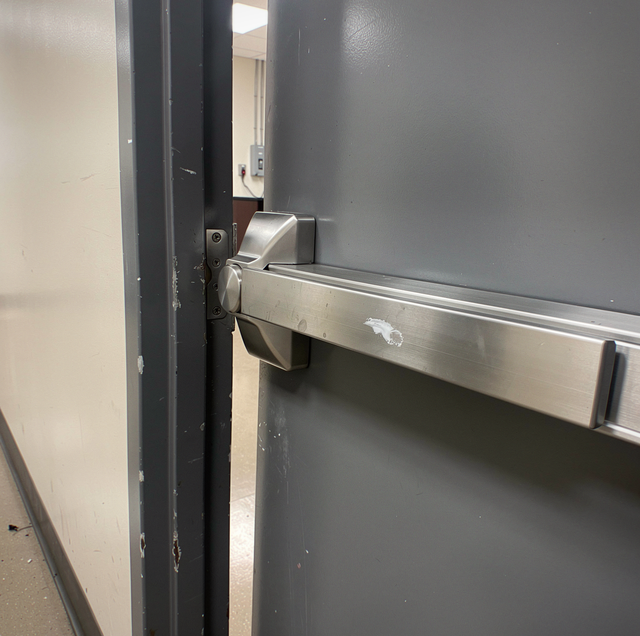
An exit door has two jobs that pull against each other. It has to keep the building closed to anyone outside, and it has to let everyone inside leave in a single motion, with no key, no code, and no knowledge of how the lock works. A person heading for a door through smoke, or in a group pressing from behind, cannot hunt for a thumbturn or grip and twist a knob. Panic hardware resolves that conflict by splitting the door in two: the push side releases on contact, and all locking functions live on the outside face. Which exits in a building need this hardware, and which type, is decided by the local building and fire officials who review the occupancy. What follows is the hardware side.
The role a door plays in the building decides its device and its outside trim:
| Door situation | Hardware approach |
|---|---|
| Main entrance with steady traffic | Rim or mortise device with a keyed lever or pull on the outside face |
| Rear exit that must stay locked from outside | Exit-only device, blank on the outside |
| Door with a keypad or card reader | Device with electrified outside trim or electric latch retraction, plus a request-to-exit switch |
| Fire-rated door | Fire-labeled exit hardware that latches on every close and has no mechanical dogging |
What a Panic Bar Does When Someone Pushes It
The bar runs across the push side of the door, and everything a person touches on that side is part of the release. Inside the housing, the push pad drives a linkage connected to the latch bolt. Pressing any point along the pad's active length moves the linkage, drawing the latch out of its strike, and the door swings free in the direction of travel. A hand, a hip, or someone stumbling into it all produce the same result, with no particular spot to find.
When the door closes again, the closer carries it back into the frame, and the spring-loaded latch rides over the strike and drops into place. That self-latching cycle is the second half of the job, because a door that drifts open after the last person leaves is open to the street, whatever hardware it carries.
The same logic sets the swing: an exit device belongs on a door that swings the way people travel out of the space. A door that swings back toward a crowd makes someone step back and pull, which a push bar cannot help.
On a standard exit device, the inside push is never disabled. Keys, codes and card readers work from the outside: through the trim, a latch-retraction motor or an electric strike, never through the inside push.
Rim, Mortise and Vertical-Rod Devices
Exit devices differ in where the latch sits, and the door and frame decide which design fits.
Rim Devices
A rim device mounts directly on the door surface. Its latch projects from the end housing on the lock side and catches a strike fastened to the face of the frame. Because nothing is cut into the door edge, a rim device suits hollow metal and solid wood doors that were never prepared for a lock body, and it can be added to an existing single door without cutting a pocket into its edge. On a pair of doors, a rim device needs something to latch against in the middle, so a pair using rim hardware carries a vertical post, called a mullion, between the leaves. A removable mullion lifts out when equipment has to come through. When the door needs an external entry, a rim cylinder passes through it and connects to the device.
Mortise Devices
A mortise exit device drives a mortise lock case set into a pocket cut in the door's edge. The bar retracts the latch in that case, and the latch enters a strike in the jamb just as it would on any mortise lock. The trade-off is preparation: the door must have, or be given, the pocket for the case, which makes a mortise device a natural fit for a door already cut for mortise hardware.
Vertical-Rod Devices
A vertical-rod device latches at the top of the door into the head of the frame and at the bottom into a strike set in the floor, rather than at the edge. Rods connect those two latches to the bar, running either on the door's surface or concealed inside the door. Because the latching happens at the top and bottom, a pair of doors can close against each other without a center post, and both leaves can serve as exits. The rods need careful adjustment so both latches release on one push and both catch on closing. A top latch that catches while the bottom one misses leaves the lower half of the leaf unsecured.
Keeping the Outside Locked and the Inside Free
The trouble starts at a back door facing a loading area or an alley, where an owner worried about break-ins reaches for a padlock, a chain through the bar, a surface bolt or a second deadbolt, and each of those turns a one-motion exit into a door that needs a key or an extra step. Security for that door belongs on its exterior face, where the exit device's trim options are located.
Exit only: The device goes on with no trim at all on the outside. That face of the door is flat, with no handle to pull and no cylinder to attack, and the only way through is the push from within.
Key-controlled trim: A lever, knob, or pull on the outside stays locked until a key turns its cylinder, which suits door staff who need to come back in from a delivery.
Night latch: A key turned in the outside cylinder retracts the latch for that one entry, and the door locks again as it closes.
An outswing door's hinges sit on the outside, within reach from the street side. Non-removable pins or security studs keep someone from pulling the pins and lifting the door away at the hinge edge. The gap at the latch edge of an outswing door can be covered with a latch guard plate to shield the latch from a pry bar.
A chain through the bar, a padlock on a hasp, or stock stacked against an exit door can trap people inside during a fire. Leave all three off; a locksmith secures the outside face with exit-device trim.
Fire-Rated Doors Have to Latch
A fire-rated door holds back fire and smoke only while it is closed and latched. An unlatched rated door can be forced open by the pressure a fire builds inside a room, so the exit hardware on it carries a second duty: it has to re-latch every time the door closes.
That duty shapes fire exit hardware in two ways. The device carries its own fire label, separate from the ratings on the door and the frame, and is built with no mechanical means to hold the latch retracted.
A rated door also limits what can be added to it. Its rating depends on the door as built and labeled, so extra holes, surface bolts, or hardware not listed for fire use can compromise it. Whether a given change is acceptable on a given rated opening is for the local fire official to decide, and a locksmith working on one reads the labels on the door, its frame and the device before anything is drilled.
Pairing Access Control With an Exit Device
Whether a business is ready to trade keys for credentials is its own decision; once a door gets a keypad or reader, the question is how that system interfaces with the exit device.
Electrified trim: The outside lever is locked or released by the access system. A valid code at the keypad frees the lever long enough for the person to turn it and walk in.
Electric latch retraction: A motor or solenoid inside the device pulls the latch back on command, either momentarily when a credential is presented or for a scheduled stretch of open hours.
Electric strike: On some rim devices, the strike on the frame releases instead, allowing the latch to pass while the device itself remains purely mechanical.
A request-to-exit switch built into the bar tells the access system that someone left from inside, so the controller does not record that opening as a forced door.
Power loss is the part to be clear on. The terms fail-safe and fail-secure describe what the outside does when power drops: fail-safe trim releases, and fail-secure trim stays locked. Neither term touches the push side. On a standard exit device, the bar release is mechanical, so the door opens from the inside with or without power.
What an Installation and Check Covers
A panic bar works only as well as the door it hangs on, so the work starts with the opening.
Door and frame: The hinges must be tight, and the door must be square in its frame. A sagging door drops the latch below the strike, leaving the latch dragging or missing the strike entirely.
Closer: Its speed is set so the door closes fully and latches without slamming or requiring anyone to pull it the last inch.
Device placement: The bar is mounted at the height and width specified by the local review, with the latch aligned on its strike.
Both sides tested: The key, keypad, or reader is tried from outside. From inside, the push is tried with the door closed under the closer's pressure, and the door is let go to confirm it relatches on its own.
Rods and labels: On a vertical-rod pair, the top and bottom latches are timed to release and catch together. On a rated opening, the device label is matched against the door's.
After installation, the warning signs are physical ones: a bar that needs a hard shove, a latch that clicks without catching, a door that bounces back open off the strike, or a rod device that leaves the bottom of the leaf loose. Each one is a fault in the release, the latching, or the way the door hangs, and on an exit door, any of them defeats the purpose of the hardware.
Frequently Asked Questions
A device that is not fire-rated can be dogged, which holds the push pad in and the latch retracted so the door works as a plain push and pull. Hex-key dogging uses a small hex key inserted into a hole in the pad and turned to lock the pad down, while cylinder dogging does the same with a regular key. Turning it back at closing lets the latch project again.
Yes, with a device built for it. A glass door in a narrow-stile aluminum frame has slim vertical frame members around the glass, and a standard device's end housing can be too wide for a stile that size. Narrow-stile exit devices are sized for those frames and come in rim and concealed vertical-rod versions.
Some can. A less-bottom-rod configuration keeps only the top latch, which removes the floor strike that debris can pack into and that carts roll over. It gives up bottom latching, so whether a given pair, and a fire-rated pair in particular, can run that way is a question for the local officials.
Yes. An alarmed exit device has a horn built into the bar housing that sounds when the pad is pushed, while the door still opens. A key switch on the device arms, silences, and resets it, so staff with the key can disarm it before using the door.
Through-bolts, sometimes called sex bolts, pass through the full thickness of the door and draw the device and a matching nut together from both faces. Wood screws alone can work loose in a wooden door under repeated pressure from people pushing the bar, and through-bolting prevents that.
A crossbar is a tubular bar across the door on two pivoting arms that swing toward the door when pushed, while a push pad is a flat pad in a fixed housing that depresses toward the door. Both retract the latch on one push. Either style can carry the same latch types and outside trim.
Secure your exit doors with panic bar installation matched to each opening — the device, outside trim, and latching are fitted and tested from both sides of the door. Lock Star Locksmith serves Pittsburgh, Bethel Park, Penn Hills. Call (412) 376-6706.