
Where to Keep a Spare Key, Ranked From Worst to Safest
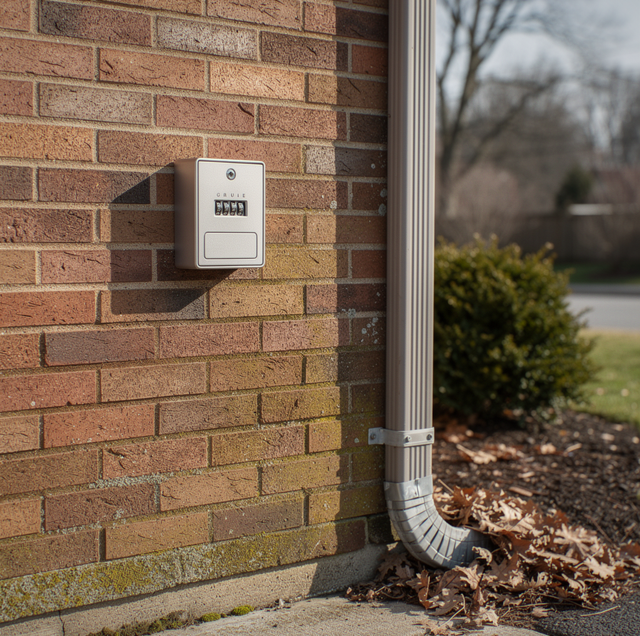
Every household needs a way back in. A kid gets home before you do, a contractor needs twenty minutes inside, a car door closes on the only key you own. So a spare goes under the mat, or into the planter beside the step, or onto the ledge above the door frame, and the problem feels handled.
It is not handled. Those are the three places a stranger checks first, and checking all three takes less time than knocking. There are six common ways to keep a spare key, and they do not perform equally well. What follows ranks them weakest to strongest, with the reason each sits where it does.
A Short Search Is What Every Spare Key Has to Survive
The measure that matters is not how clever a spot feels. It is how long the key stays unfound by someone standing at your door in view of the street, unwilling to look like they are searching. That is a short, shallow look at the places everyone uses.
Convenience and predictability are the same property: the usual spots are within reach of the lock and require no walking, which is why they are the ones anyone would check. A key found that way also leaves nothing behind. No forced frame, no broken glass, no marks on the cylinder. It goes back where it was, and you keep using that lock for years without knowing anything changed.
The Key Itself Is Easier to Copy Than You Expect
Three facts about the metal object shape every option below.
A key stamped 'Do Not Duplicate' is not protected. The stamp is a request aimed at whoever stands at the key machine, and nothing in an ordinary blank enforces it. Restricted keyways, where the blank itself is controlled and sold only to authorized holders, are a different product bought deliberately.
A photograph of a key is close to a key. The cuts carry the information, and they are legible in a clear picture taken from a few feet away. Never text or post an image of your key, and check the background before posting a photo of a kitchen counter or a hallway table.
A tagged key is the worst version of any option. One labeled with an address, or with the word Front, hands over both halves of the problem at once. If a copy has to be identifiable, mark it with a color of tape or a number that is not the house number.
One consequence gets skipped. A key kept outdoors sits in a lock that never gets rekeyed. If you cannot say that nobody has ever picked it up, put it back and walked away, you do not know who can open your front door. When that is the question, changing the pins in the cylinder answers it, and no storage method can.
Mats, Planters and Door Frames Fail First
These sit at the bottom of the ranking, and it is not close. The mat, the planter, the ledge above the frame, the mailbox, the magnetic box under a porch rail, the key taped behind a downspout: every one is within a step of the lock, and every one is a suggestion you have already heard.
Fake rocks deserve their own sentence. They are molded in a small number of shapes and finishes, and they weigh wrong for their size, which is why they read as what they are at a glance. If your spare is in any of these, the accurate description of your front door is that it opens for anyone willing to spend a minute on the porch.
Distance From the Lock Beats Cleverness Every Time
The useful variable is not ingenuity. It is distance, plus the absence of any reason for the spot to be connected to the door. Anything within arm's reach of the cylinder is on the doorknob in practical terms, because a person can stand at the door and reach it without appearing to do anything at all. Move the key thirty or forty feet out, to something with no visible relationship to the entry, and the value is not that the spot is unguessable but that guessing costs time in the open.
The limits show up in ordinary use. You will be retrieving it in the dark and the rain, and the spot has to survive mulch deliveries, snow cover, and your own memory six months on. It is also still an unmanaged key outdoors, so the never-rekeyed problem applies in full. A step up from the doormat, not an answer.
A Key With a Neighbor Is Strong but Slow
This option is stronger than its reputation, and underused because it requires asking. The key sits indoors, behind someone else's locked door, attached to someone who knows your car and whether you are supposed to be home. Nothing on your property holds a key, which takes your house out of the search entirely.
The limits are availability and awkwardness, not security. The neighbor travels, works nights, or is asleep at two in the morning while you are on the step in a coat with no key. Ask two households rather than one, pick people whose schedules do not overlap, tell them where it lives inside their house so a spouse can find it, and hand it over unlabeled.
Ask properly, and accept a no. A reluctant yes is the door that does not open at midnight.
What Separates a Decent Key Safe From a Bad One
A mounted key safe is the realistic middle for most households, and quality varies enough that the category name tells you nothing. Four things separate the ones worth mounting from the ones that only look it.
The body. A cast or forged metal shell behaves differently from a thin shell with a metal-look finish over plastic, and the difference shows in the hand: weight, and whether door and body meet without flex.
The code. On a wheel type, four wheels rather than three. Set it to something unrelated to you, and change it whenever someone who knew it no longer needs access.
Count the digits before you buy. A four-wheel code has 10,000 possible settings against 1,000 for a three-wheel. Skip your house number, a birth year, a street number, and any four repeated digits.
The shrouding. Watch the dial or pad from a few feet to the side while somebody enters a code. If they read clearly from the sidewalk, the code is not private, and a cover that hides the pad during entry is worth more than another wheel.
The mounting. Bolted through into a stud, a framing member, or masonry. Screwed into vinyl siding or a hollow section, the safe is attached to the skin of the house and not to the house, which is also why the hanging shackle type, hooked over a doorknob or a railing, ranks below the mounted type. Keep it out of the street's sightline, and expect the weather to act on it: a dial stiff in January cold, grit in the wheels by August, water inside the housing if there is no cover.
Keyless Entry Removes the Spare Instead of Hiding It
A keypad deadbolt or a smart lock changes the shape of the problem rather than answering the storage question. There is no object outside to find, because access is a number rather than a thing, and a number can be withdrawn from a person without collecting anything from them. That is what puts it at the top of the daily-access ranking.
It does not close the ranking because most models retain a mechanical key override, so a physical key still exists and has to live somewhere. Park that override under the mat and you have moved the weak point rather than removed it. It is the best candidate for the last option on this list.
The Copy You Hope Never to Use Belongs Off-Site
The strongest option is not a convenience, and treating it as one ruins it. This is the copy for total loss: every key gone at once, a wallet and a keyring together, a fire, a flood. It belongs somewhere unrelated to the property, such as a safe deposit box, a locked drawer at work, or a relative's house in another town.
It ranks first because no search of your property reaches it, and it is useless on a Tuesday afternoon, because retrieval takes a day and often a trip during business hours. That is the trade the ranking runs on: the safer the storage, the slower the access. So do not ask one key to do both jobs. Keep the disaster copy unlabeled, and record where it lives somewhere that is not alongside the key.
Frequently Asked Questions
No. A vehicle is entered far more casually than a house, and a house key in a glove box sits next to a registration carrying your address. Cars in driveways also often hold a garage door remote, which pairs a second way in with the first.
Fewer than most homes carry. A working rule is one copy per adult who needs daily access, one off-site copy, and none unaccounted for. The number matters less than the accounting: if you cannot name the person holding every copy, you have lost track of your own door.
Yes. A key can be originated from the lock itself rather than duplicated from another key, which is why losing the last copy is an inconvenience rather than a hardware replacement. Expect to prove you belong there: a legitimate locksmith will ask for photo identification and something that ties you to the address.
Treat it as found rather than lost, because you have no way to tell the difference. The detail that decides how urgent it is: whether that key was ever out of your sight long enough to be pressed into something. A key impression takes seconds and leaves the original untouched, which is why 'it turned up again the next day' is not the reassurance it sounds like.
Yes. Battery-powered deadbolts run on their own cells, so a neighborhood outage does not shut you out. What an outage or a router failure stops is the remote side — adding or deleting a code from a phone — so the codes already stored in the lock keep working while the ability to change them does not. That is the argument for issuing a household member a code of their own rather than relying on being able to grant one remotely when they are standing at the door.
Always from the original. Every duplication reproduces the cut depths with a small amount of error, and a copy taken from a copy carries both generations of it, which is why a third-generation key is the one that drags or turns one lock and not another. Keep one key as the reference and cut every spare from it.
Replace a hidden key with access you can actually revoke — a technician can rekey the cylinder, fit a keypad deadbolt, or mount a key safe into the structure so the spare stops being the weakest part of your door. Lock Star Locksmith serves Pittsburgh, Bethel Park, Penn Hills. Call (412) 376-6706.
