
Change a Lock Without a Locksmith? The Interchangeable Core
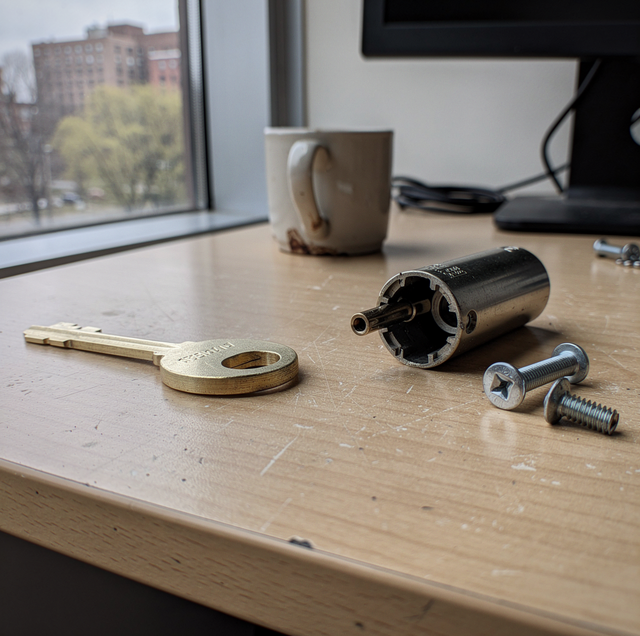
Two buildings replace the same lock on the same Tuesday morning. First, a technician pulls the lever trim and works the cylinder at the doorway for as long as the keying change takes. The opening stays out of service the whole time.
At the second, the office manager walks down with two small brass pieces in one hand, turns a key in the lever, lifts one piece out, drops the other in, and turns the key back. The door was never out of service.
The second building runs small-format interchangeable cores. The working part of every lock in the place comes out as a single brass unit, keyed to that single purpose, and your building owns that key.
The Core Is the Working Half of the Lock
A commercial lever set does two separate jobs at once. It carries a latch, throws it, retracts it, and absorbs a few hundred hands a day. It also has to work for one key and turn for nothing else. In most hardware, those two jobs live in the same assembly, which is why changing which key works on your door means opening the lock. A small format interchangeable core pulls the second job out into a part of its own.
The core is a brass unit about the size of a thumb, shaped like a figure eight, and it holds everything related to which key operates the opening. The latch, the chassis, the lever, the springs, and the strike your door closes against all stay put. When the keying changes, the core leaves and the lock never moves.
One Core Shape Fits Levers, Deadbolts and Padlocks
The figure-eight outline is the point of the whole arrangement. A lever set built for it, a deadbolt built for it, a rim cylinder behind an exit device, a padlock body, a cabinet lock on a supply cage: every one of those housings is machined for the same core envelope. One core fits all of them, which means a building can run every keyed opening it has on a single family of parts.
That matters more than it sounds. In a building on conventional hardware, the front deadbolt, the stockroom lever and the padlock on the roof hatch are three different cylinders in three different housings, and rekeying them is three visits to three of your doors. On cores, they are three of the same part. The keying work is identical at each one, and the hardware underneath is irrelevant to it.
The limit sits in the housing. A core needs a figure-eight pocket and a groove for its retaining lug, and a housing bored for an ordinary cylinder has neither of those. So the reach is real inside a system, and it ends at the system's edge: your cores move freely among the openings built for them and go no further.
The Control Key Is Cut for a Different Job Entirely
Every core in the system is built for two different keys, cut to two different patterns, doing two unrelated jobs. The operating key is the one on a staff ring: it turns in the keyway, the latch retracts, the door opens, and nothing about the core moves. The control key enters the same keyway and turns further than the operating key can. It throws no latch and opens no door. It withdraws a small, hardened lug from the side of the core body, clearing it from the housing groove that has been holding the core in place. The core slides straight out of the lock into a hand, still assembled, still carrying its keying.
Two different populations hold those keys. Operating keys go out by the dozen to your staff, your tenants, and outside contractors, and they are expected to circulate and get lost. Control keys are issued in ones and twos to whoever your building trusts with the ability to change a lock. A key that opens a door and a key that changes which key opens it are different animals.
A core in the hand is only brass and springs. The key that put it there is the part of the system with real reach, and it lives on a very short list.
A Housing Cut for a Core Will Not Take a Standard Cylinder
This is the part that has to be handled at the time of purchase. A building running conventional hardware cannot be moved onto cores by ordering a box of cores. The housings are wrong. Converting an opening means new hardware at that opening, whether that is a lever set prepped for a core, a mortise housing that accepts one, or a rim cylinder for the exit device already hanging on the door. It is a hardware change, with the scheduling a hardware change brings.
Format matters too. Small format cores share one outline and one size, so one maker's core seats in another's housing. Each larger format is cut to its own maker's dimensions. Getting the format wrong on a single order leaves you with cores that will not enter the housings you already own.
The Bench Work Happens Before the Core Ever Reaches the Door
Re-pinning a lock at the door is a real job, and it takes a real amount of time. A technician works at the opening, enters the cylinder, changes the keying, reassembles, tests the key both ways, tests the latch, and confirms that the door still closes and locks as it did before. During all of that, the opening is not usable. On a corridor door or a stockroom, that is an inconvenience. On your main entrance during business hours, it is a problem.
A core exchange moves that work off the door entirely. The new core is keyed at a bench in the shop, days or weeks ahead, and it arrives at your building already carrying the keying it will hold. At the door: a control key in, a quarter turn, the old core out, the new core in, and the key back. The opening is out of service for the duration of that motion, rather than the length of a service call, and the person doing it never picks up a tool.
That difference changes the staffing question too. Because the keying was finished at the bench, the exchange at the door carries no keying judgment, which is why your office manager or maintenance lead can do it. The locksmith's work went into the core before it ever left the shop, and what is left at the door is measured in seconds.
Who Holds the Control Key for the Building?
Once a building runs on cores, the question of who can change a lock is no longer a question of hardware. Any core in the place can be exchanged in seconds by anyone holding the control key, which makes that key the shortest path to your building's keying. It is worth knowing how many control keys exist, who has them, and what happens to that person's copy when they leave.
A building that has lost track of its control keys is not stuck. Whoever built the system typically holds the keying records, which show how many were cut and to whom. Whether a building eventually outgrows physical keys altogether is a separate question about electronic access. Changing a lock on a door is a technician's job; changing a lock across your building is a matter of who holds the control key.
Frequently Asked Questions
It is the keyed part of the lock, built as a self-contained unit that lifts out of the housing on its own key rather than being taken apart in place. Cores in a keyed system are stamped with that system's code, so a spare already in your drawer is identified by sight, without trying it in your door, which matters when your shelf holds several.
Whoever you would trust to change every lock in the place, which is usually an owner or a single named manager. Some buildings keep none on site at all and leave the only control key with the locksmith who built the system. You give up the seconds advantage on an unplanned change, and you gain a very short custody list to manage.
Not by swapping in a core, because the housing has to be made for one. In practice, your lockset itself is replaced with a version prepped for a core. The good news for your building is that the standard cross bore a commercial bored lock already sits in, about two and an eighth inches, usually stays exactly as it is, so your carpentry does not change at all.
It does not touch it. No trim comes off, no screws come out, no mounting plate is loosened, and the latch and strike stay where they were adjusted. It matters most on a rated opening in your building, where the labeled hardware and the way your door was hung carry the rating, and where the fewer things you disturb, the better.
It compromises the ability to change locks, which is serious enough to act on. The repair is to re-core the system to a new control, meaning every core in the building is exchanged for one cut to a different control key. In many systems, your operating keys can stay exactly as they are, so your staff never notices, and your key issue list is untouched.
Turnover. Every move-out in your portfolio is a lock change, and on cores that change happens without booking anyone. The second reason shows up only at the portfolio level: a control can be specified to cover multiple properties, so one control key in your pocket serves every building you own. That is written into the order when the systems are built, because bringing two existing systems onto a common control means re-coring both.
Planning a keying system for a commercial building, or determining whether existing openings can accommodate interchangeable cores, is a conversation worth having before hardware is ordered — a walkthrough of your doors and their housings comes first. Lock Star Locksmith serves Pittsburgh, Bethel Park, Penn Hills. Call (412) 376-6706.
