
What Makes a Lock High-Security (and When You Need One)
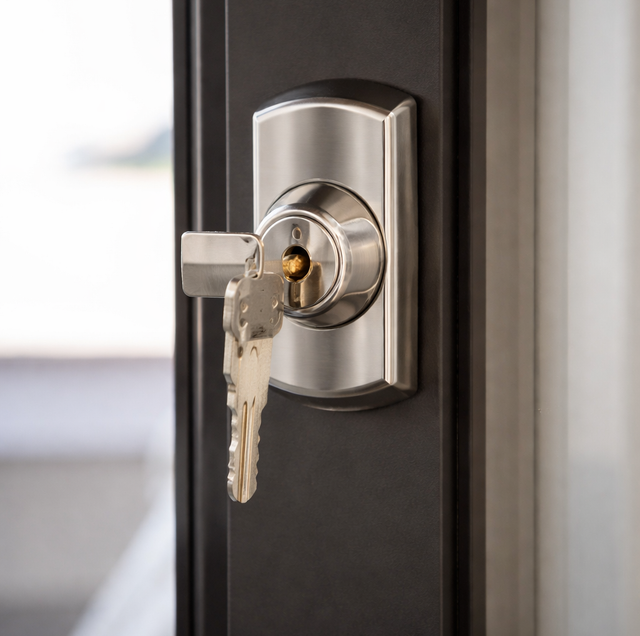
Quick Answer: A high-security lock resists the common ways a lock gets defeated- picking, bumping, drilling, and unauthorized key copying- by combining hardened internal parts, a controlled key system, and physical strength against force. A basic lock stops casual entry; a high-security lock is tested and rated to slow down a determined attempt.
Most locks sold at a big-box store are built to keep an honest person honest. They turn a knob, throw a bolt, and stop the door from drifting open. What they are not built to do is stand up to someone who has decided they want in and has a few minutes of privacy to work. A high-security lock is engineered for that second situation, and understanding the difference is the first step in deciding whether you actually need one.
Basic Lock Versus High-Security Lock
A standard residential deadbolt or knob lock uses a fairly simple pin system inside the cylinder and soft metal that machines easily. That keeps it cheap to make and easy to copy a key for, which is exactly why it works for everyday use. The trade-off is that the same simplicity that makes it convenient also makes it quick to defeat for anyone with basic knowledge and the wrong intentions.
A high-security lock starts from the opposite priority. Every design choice is made to add time, difficulty, and traceability to an unauthorized entry. It costs more, and the keys are harder to duplicate on purpose. A basic lock is like a screen door latch, and a high-security lock is like a bank vault door: both keep a space closed, but only one is built assuming someone will really try to get through it.
The features below are what create that difference. None of them work in isolation, and a lock is only as strong as its weakest layer.
The Elements That Make a Lock High-Security
A restricted or patented keyway: On an ordinary lock, the blank key can be bought and cut at almost any hardware counter. A high-security cylinder uses a restricted or patented keyway, meaning the key blank itself is legally protected and only sold to authorized dealers or the registered owner. A copy cannot be made off the street, so you control exactly how many keys exist and who holds them. For a landlord, a business, or anyone who has handed keys to contractors or former staff, this key control is often the single most valuable feature.
Anti-pick pin design: Inside a lock cylinder, pins have to line up for the plug to turn. High-security cylinders use specially shaped pins, commonly spool and serrated types, that catch and give false feedback when someone tries to manipulate them. They also often hold more pins and tighter tolerances than a basic lock. The result is a cylinder that resists manipulation far longer, which matters because most opportunistic attempts are abandoned when they take too long.
A sidebar or secondary locking mechanism: Many high-security cylinders add a second locking element beyond the standard pin stack, such as a sidebar that reads a separate cut or set of interactive elements on the key. The plug will not turn unless both systems are satisfied at once. This second layer is a large part of why these cylinders are so much harder to defeat than a conventional one, since satisfying one system does nothing on its own.
Hardened steel anti-drill protection: Because manipulation is slow, a determined attempt may shift to force against the cylinder. High-security locks answer that with hardened steel pins, ball bearings, or plates embedded in the cylinder that resist and dull cutting tools. These hardened inserts protect the parts of the mechanism most vulnerable to being bored through, adding meaningful time and difficulty to a forced attempt.
A reinforced bolt and strike: The cylinder is only half the lock. The bolt that extends into the frame and the strike plate it lands in carry the load when a door is hit or pried. High-security systems pair a solid, deep-throw bolt with a heavy strike plate anchored by long screws that reach the wall stud, not just the thin door jamb. This is where resistance to a kick or shoulder actually comes from, and it is the layer most often overlooked.
An independent rating or grade: You do not have to take a marketing claim on faith. Independent testing bodies grade locks on how they hold up to force, wear, and manipulation attempts. A published grade from a recognized standard tells you the lock was tested rather than described as strong. When you compare options, the grade is your most objective signal that a lock earns the high-security label.
What Each Feature Actually Protects Against
It helps to match each feature to the problem it solves, because you may care about some far more than others.
Key control from a restricted keyway solves a people problem, not a mechanical one. It matters when keys have circulated, and you cannot be sure who still has a working copy. Rentals, offices, and any master-key setup live and die by it.
Anti-pick pins and a secondary locking mechanism address quiet, tool-based manipulation, the kind of attempt meant to leave no trace. Drill-resistant hardened parts address the louder, faster escalation when quiet methods fail.
Forced-entry resistance, the kick-in or pry, is mostly about the bolt, strike, and frame rather than the cylinder itself. A perfect cylinder in a hollow door with a strike held by short screws still fails to a hard kick. That is why serious installs reinforce the door edge, hinges, and frame alongside the lock.
Who Actually Needs One
Not every door needs a high-security lock, and it is fair to weigh the cost against your situation. The clearest cases are businesses protecting inventory, records, or after-hours access; landlords and property managers who need to guarantee key control between tenants; and anyone running a master-key system where one lost key could otherwise compromise many doors.
Homeowners benefit most on the doors that matter, usually the main entry and any door hidden from the street where someone could work undisturbed. Someone who has recently moved, lost a key, or gone through a breakup where keys were shared has a strong reason to at least rekey, and often to step up to controlled keys. If peace of mind about who can make a copy of your key keeps you up at night, that alone is a valid reason.
The Door and Frame Matter as Much as the Lock
A high-security lock installed in a weak door is a strong deadbolt on a flimsy foundation. The bolt can only push against what it is anchored to, so a rotted jamb, a hollow-core door, or a strike plate held by short screws undoes much of what you paid for. A proper high-security install treats the opening as a system: solid door, reinforced strike, long screws into the stud, and protected hinges all working together.
A double-cylinder deadbolt needs a key to open from the inside as well as outside, which can trap people during a fire or emergency when a key is not immediately at hand. Where you use one, keep egress and local safety practice in mind, and talk it through with a professional before choosing that configuration.
Because so much of the value depends on correct fitting and on setting up the key control properly, high-security work is a good place to bring in a licensed locksmith rather than treating it as a swap-it-yourself upgrade. The hardware and the installation together are what deliver the protection the grade promises.
Frequently Asked Questions
There is no single number, because it depends on the method attempted and the exact rating. The point of the design is not to be unopenable but to push past the few-minute window most opportunistic attempts are willing to spend. Ratings from independent testing describe resistance in terms like minutes of forced attack or thousands of operating cycles, which is a more honest way to compare locks than any single time claim.
Yes, but only through the authorized channel. Because the blank is legally controlled, a duplicate is made against your registered account, often requiring signed authorization or ID rather than a walk-in at a counter. That paper trail is the feature working as intended. If a key goes missing entirely, rekeying the affected cylinders is the clean fix, so any stray copy stops working.
Not automatically. A smart lock adds electronic access and remote control, but its physical resistance to picking, drilling, and force still depends on the mechanical cylinder and bolt underneath. Some smart locks pair with a graded high-security cylinder, and some use a basic one behind a keypad. Judge the mechanical grade separately from the electronic convenience.
A bump key is a manipulation technique that exploits the simple pin stack in ordinary cylinders. The relevant point for a buyer is that high-security cylinders using spool or serrated pins plus a secondary locking element, like a sidebar, are specifically engineered so this class of attack does not work the way it does on a basic lock. It is one of the main reasons the internal parts are shaped the way they are.
Often, but not always without modification. Standard deadbolts use common bore sizes, and many high-security models are built to drop into those. Older doors, unusually thick or thin doors, or doors with worn or misaligned bores may need a machinist's adjustment or a new strike location. A locksmith can measure the backset, bore, and door thickness before ordering so the fit is right the first time.
Usually just some. Interior doors and doors that are always visible from a busy street get less benefit. Concentrate the investment on primary entries, back and side doors screened from view, and any door protecting valuables or business records. Matching the grade to the actual exposure of each opening is more sensible than uniformly upgrading everything at once.
Ask about a high-security upgrade for the doors that matter most — get key control and tested protection sized to your property. Lock Star Locksmith serves Pittsburgh, Bethel Park, and Mt. Lebanon. Call (412) 376-6706.
