
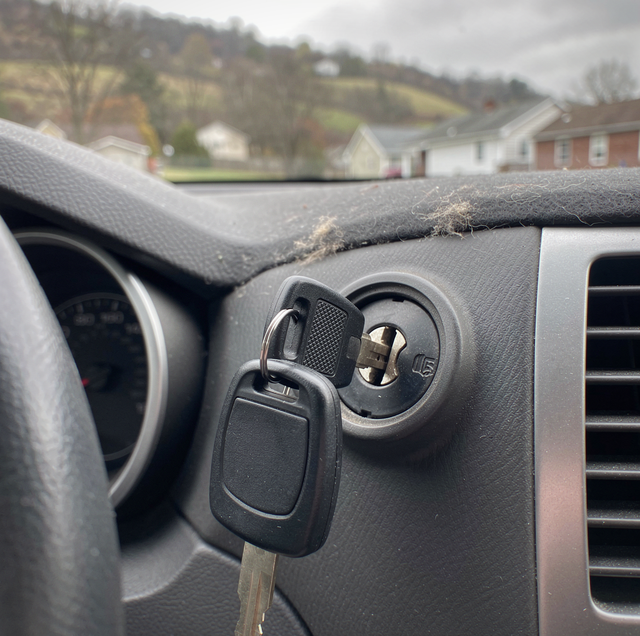
The key is all the way in. It seats with the click it always makes; the head sits flush against the housing, and when you turn it, nothing moves. Not a few degrees, not a grudging quarter turn. Then you notice the wheel has a little play in it, an inch or two at the rim before it stops solid.
Start with the steering column lock. It is the one cause that clears in five seconds in your own driveway, and the play in the wheel is why you should suspect it. If that does not free the key, the order runs to the shifter, then your key, then the cylinder, and each announces itself differently in your hand.
The Steering Column Lock Binds Against the Cylinder
Rotating the plug out of the locked position withdraws a steel pin from the steering shaft; that pin is what keeps the wheel immovable while the key is out, so your cylinder is always dragging the pin with it.
If the front wheels were left short of straight when you parked, or turned against a curb, the tires push back through the steering linkage and load the pin sideways in the notch it dropped into. The friction holding it is proportional to that side load, and no force on your key reaches it, because the key is upstream of the jam. Rock the wheel a few degrees each way with one hand while you keep light, steady pressure on the key with the other. Somewhere in that arc the side load drops off, the pin slides clear, and the key turns. Keep the pressure light throughout: release comes from unloading the pin, and extra torque only bends the key.
Is Your Automatic Really All the Way in Park?
On an automatic with a keyed ignition, the shift lever and the lock housing are tied together by a cable or linkage. That interlock runs both ways: it prevents the lever from leaving Park unless your foot is on the brake, and it prevents the plug from rotating back toward locked or the key from coming out unless the transmission is in Park. Where the block acts on the cylinder, a shifter problem arrives in your hand as an ignition that will not turn.
The lever can look right and still be short. A stretched cable or a worn detent leaves the pointer on Park while the transmission sits a few millimeters shy of the position that satisfies the interlock. Set the parking brake, put your foot on the service brake, move the lever out of Park and firmly back into it, then try the key. If your key also refuses to come out of the accessory position on other days, that is the same linkage seen from the other side.
What Wears Inside an Ignition Cylinder
An ignition cylinder is built around flat wafers riding in slots cut across the plug. Look at your key: cuts along both edges, working either way up, mean wafers entering the plug from both sides. Every wafer has to sit flush with the plug's outer surface for the plug to rotate, and one wafer standing proud holds everything.
A car works that arrangement in ways a lock on a house door never sees. Every start turns the plug against the column pin and against the spring that snaps the key back from start. A loaded keyring adds a load of its own: it bends the key while it sits in the cylinder, and the plug carries that bending at the mouth of the keyway, so the front wafer slots wear first and wear out of round. A plug worn that way turns only for a key held one particular way, lifted or pushed hard or drawn a hair back out, your hand compensating for a plug that no longer holds it square. Cold is a separate matter: an ignition that binds on the coldest mornings and frees by afternoon is reacting to temperature rather than wear.
The Key Wears in a Way You Cannot See
Your key is the part that gets cycled. Every insertion drags its cut edges across the wafers under load: in the ignition, the door, and the trunk, while each of those cylinders only ever meets one key. The peaks between the cuts round off, and a rounded peak leaves its wafer a little low. Once that has happened across five or six cuts, no single one is badly wrong while all of them are slightly wrong.
Copies make it worse: a duplicating machine traces whatever key you hand it, so a copy of a worn original inherits that wear and adds error of its own. One test with the spare in your kitchen drawer splits the problem in two. If the spare turns and your everyday key does not, the wear is in the key and the cylinder is healthy. If both stop at the same point with the same feel, the plug is worn, and a fresh key will not rescue it. If neither turns while the wheel still has play, you never got past the column. Stop after the second attempt either way: a worn key in a worn cylinder is how a key tip snaps off inside the plug, and that extraction is the larger job.
Debris and the Wrong Lubricant in the Keyway
An ignition keyway faces up or sideways inside the cabin, open all day to pocket lint, grit off your hands and whatever falls off the ring. The wafer slots are open to it too, and material packed behind a wafer stops it dropping flush as surely as wear does.
An oil-based spray or a penetrating fluid does relieve the friction for the first few turns. It also does not dry. It stays in the slots, holds every particle that lands afterward, and the paste that forms grinds at the wafer edges and slot walls, accelerating the wear you applied it to relieve. A dry film is the version that helps: powdered graphite or a PTFE lock lubricant leaves a slick surface without a carrier that traps grit. Use it sparingly. The electrical side of the ignition sits immediately behind the lock, so a liquid sprayed into that keyway has somewhere to travel that a door keyway does not.
Why the Key Gets Replaced First, and When to Stop
The order runs from what you can reverse in the driveway to what requires opening the car, and your key sits ahead of the cylinder because it is the only part you can swap in half a minute. A worn key also works on the cylinder every time it goes in; its rounded cut edges bear on the wafer faces at angles they were never cut for, so a key with rounded peaks gets replaced whatever else turns out to be wrong.
Stop and call if your key visibly flexes under normal pressure, if a piece has broken off in the keyway, or if the plug spins freely with no resistance, which means something inside has sheared. Leave the steering wheel itself alone, whatever the symptom: the airbag module sits in the hub, and behind it sits the clockspring, a coiled ribbon cable carrying the horn and airbag circuits through every rotation of the wheel, which tears if the hub is turned while the wheel is off the column.
Frequently Asked Questions
Yes, with light pressure on both. The pin you are freeing engages a lock plate clamped to the steering shaft, and that plate sits behind the wheel under a retaining ring, which is why anything in there is shop work rather than a roadside repair. Pressure at the rim supplies all the movement the pin needs; release comes from taking the side load off it.
Each wafer is returned by its own small spring, and a weak spring or a silted-up slot lets one wafer hang a fraction of a millimeter proud of the plug. Whether it settles flush depends on how quickly your key went in and how the ring hung off it. An ignition that works on the third try has the same fault, caught earlier.
Not on its own. Both cylinders are cut from the same key, but they do not necessarily read the same part of it. Where a door cylinder uses fewer wafers than the ignition does, a key worn past what the ignition accepts can keep working the door for months. A spare tells you far more than the door does.
Not necessarily. A replacement cylinder arrives with its own wafers, and a technician can re-wafer it to the key you already carry, so one key still works the doors, the trunk and the ignition. The electrical switch behind the cylinder is a separate part on the same housing, and it can stay where it is.
A fresh cut leaves small burrs along the edges, and those burrs drag on the wafers until a few dozen insertions wear them off, so your new key can feel tighter than the worn one it replaced. What should not happen is a key that catches at one point and stays there. Take that one back to whoever cut it: it points at the cut rather than at your cylinder.
With a gauge rather than by eye. Every keyway has a depth and space specification: a fixed set of numbered cut depths and a fixed spacing between cut positions. A locksmith reads each cut against it with a key gauge or a decoder, so a worn cut resolves to a number between two legal depths. The new key is cut to those depths, or to your key code.
A worn key and a worn cylinder produce the same key-in-lock refusal, and they require different repairs — a mobile automotive locksmith comes to the car, separates the two on-site, and can re-wafer a replacement cylinder to the key you already carry. Lock Star Locksmith serves Pittsburgh, Bethel Park, Penn Hills. Call (412) 376-6706.