
Mortise vs. Cylindrical Locks: Which Guards Your Door Better
Two doors can look nearly identical from across the room and still hide completely different hardware inside the door itself. One might carry a lock body threaded through a couple of round holes; the other might have a heavy rectangular case buried in a pocket cut into the door's edge. Those two approaches, cylindrical and mortise, are the main lock body types you will meet on residential and commercial doors, and knowing which one you own changes how you repair it, rekey it, and upgrade it.
The difference is not about the key or the finish you see on the face. It is about how the working mechanism is mounted in the door. Get that part clear, and the rest of the comparison falls into place.
Quick Answer: A cylindrical lock is installed through round bored holes drilled through the door face and edge, which makes it inexpensive and quick to fit. A mortise lock sits inside a rectangular pocket machined into the door's edge, holding its latch and deadbolt in one heavy case that is stronger and longer lasting but harder to install.
How Each Lock Body Is Built Into the Door
Before comparing strength or price, look at the mounting method, because that single detail drives everything else.
The cylindrical (bored) lock: A cylindrical lock, sometimes called a bored or tubular lock, mounts through holes that a drill can make on site. There is a large round hole through the face of the door for the lock chassis, and a smaller hole bored into the edge for the latch. The knob or lever assembly clamps together through that face hole, and a separate cylinder accepts the key. On an exterior door, this style is almost always paired with a separate deadbolt mounted a few inches above it in its own second bored hole. So a typical home entry door has two bored units working together: the knob or lever latch for everyday closing, and the deadbolt for real security when locked.
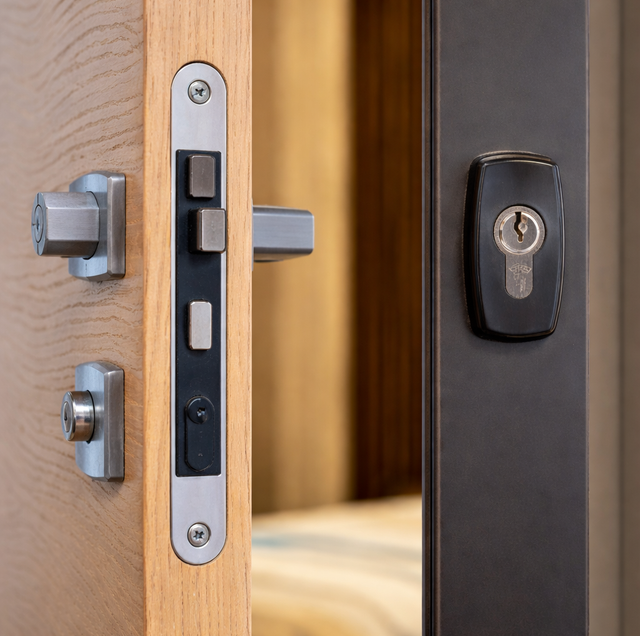
The mortise lock: A mortise lock takes its name from the mortise, the deep rectangular pocket a woodworker or machine cuts into the vertical edge of the door. Into that pocket slides a rectangular steel lock case that houses the latch bolt, the deadbolt, the levers, and the springs together in one body. A trim plate, knobs or levers, and a cylinder attach to the outside of that buried case. Because the case is fully enclosed by the door material around it, the whole assembly is braced by the door on every side rather than pinched between two washers.
That structural contrast, a compact chassis held in round holes versus a full steel case seated in a machined pocket, is the root of the durability, security, and cost differences that follow.
Cylindrical Locks: The Everyday Workhorse
Most homes built in recent decades run on cylindrical hardware, and for good reason.
Fast to install and replace: Because the mounting is just standard bored holes, a cylindrical lockset drops in with a screwdriver once the holes exist. Swapping a worn knob for a new lever, or replacing a failed deadbolt, is a short job with common tools. Standard bore spacing means most replacement locks fit the existing holes without new drilling.
Lower cost and wide selection: Simpler construction and mass production keep cylindrical locks on the affordable end, and the aisles are full of finishes, styles, and grades to match a home.
Good security when specified right: A cylindrical latch alone is not meant to secure an exterior door against force; that job belongs to the accompanying deadbolt. A quality deadbolt with a one-inch bolt throw and a reinforced strike plate anchored into the door frame's stud gives a home solid protection. The security lives in that deadbolt and its strike, not in the knob.
The tradeoff is that a bored lock relies on the door and frame around two separate holes rather than one reinforced case. For a well-hung residential door with a good deadbolt, that is plenty. For a door slammed hundreds of times a day, the story changes.
Mortise Locks: Heavier and Built for Constant Use
A mortise lock is what you tend to find on older houses, apartment building entries, schools, offices, and higher-end residential doors.
One case, two functions: The single steel case holds both the spring latch and the deadbolt. Turn the inside thumbturn or use the key, and the same body throws a deadbolt right next to the latch. There is no separate second lock to install and align, because both live in one unit.
Sturdier and longer lasting: The parts inside a mortise case are generally larger and heavier than the compact works of a bored lock, and the case is fully supported by the surrounding door. That combination stands up to heavy cycling, which is why building owners specify mortise hardware for doors that see constant traffic. Many mortise locks also accept anti-friction latches and heavy-duty trim that hold up under abuse.
A more secure, more solid feel: Beyond the measurable durability, mortise hardware simply operates with a heavier, more deliberate action that owners of vintage and high-end doors value. The trim options run toward the ornate, which suits heritage and architectural doors.
The catch is installation. Cutting a clean, correctly sized mortise pocket into a door edge takes skill, the right jig or chisels, and time. Retrofitting a mortise lock into a door originally bored for a cylindrical lockset is real carpentry, and doing it wrong weakens the door. That labor is why mortise hardware costs more to fit and to retrofit than a comparable bored set.
How to Tell Which One You Have
You do not need to remove anything to identify your lock. Open the door and study the edge where the latch sticks out.
Look at the faceplate on the door edge: A cylindrical lock shows a small, roughly rectangular or rounded faceplate around the latch, and if there is a deadbolt, you will see a second, separate faceplate a few inches away. Two distinct plates, spaced apart, mean two bored units.
Look for one large plate: A mortise lock shows a single tall faceplate, often several inches long, with both the angled latch bolt and the square deadbolt poking through that same plate. One long plate carrying two bolts is the signature of a mortise case inside the door.
Check the door face: A cylindrical setup usually has a knob or lever plus, on exterior doors, a separate thumbturn or key cylinder above it for the deadbolt. A mortise setup often combines the handle and the keyed cylinder into one coordinated trim set, with a thumbturn that works the built-in deadbolt.
To tell which lock you have without removing anything, open the door and look at the faceplate on the edge. A cylindrical setup shows a small latch plate plus a separate deadbolt plate a few inches away, while a mortise lock shows one tall plate carrying both the angled latch and the square deadbolt.
Comparing the two is a little like the difference between a bolt-on shelf bracket and a shelf let into a routed groove: one is fastened to the surface and quick to change, the other is set into the material for a more permanent, load-sharing hold.
Durability and Security Tradeoffs Side by Side
Neither type is simply better; each wins in a different setting.
Durability: Mortise wins on raw longevity and resistance to heavy cycling because of its larger internal parts and fully braced case. A cylindrical set is entirely adequate for a home but wears faster under commercial-grade traffic.
Security: A mortise lock's integrated deadbolt and enclosed case give it a strong baseline. A cylindrical setup can match strong protection when paired with a high-grade deadbolt and a reinforced strike plate screwed into the framing, not just the jamb trim. The weak point in either system is usually the strike and frame, not the lock body, so reinforcing where the bolt lands matters as much as the lock you choose.
Fit for the door: Match the lock grade to the door's use. A busy commercial entry deserves mortise or heavy-duty cylindrical hardware rated for high cycle counts. A bedroom or closet door does not need either.
Where Each Type Fits Best
Choose cylindrical for most homes: For typical residential entry, interior, and secondary doors, a quality cylindrical lever or knob plus a good deadbolt covers the need at a sensible cost and stays easy to service.
Choose mortise for high-traffic, commercial, and heritage doors: Apartment building entries, offices, storefront back doors, and doors that open and close all day benefit from mortise durability. Vintage and architectural doors that were originally cut for a mortise pocket should generally stay mortise, both to preserve the door and because the pocket is already there.
A note on fire-rated doors: Rated doors in commercial and multifamily buildings carry hardware matched to their fire rating. Changing the lock type on a fire-rated door can affect its rating, so that work belongs with a professional who keeps the assembly compliant.
Repair, Rekey, and Retrofit Considerations
Rekeying: Both types can usually be rekeyed to a new key without replacing the whole lock, as long as the cylinder is a standard, serviceable type. Cylindrical locks tend to be quick to rekey because the cylinder pulls out readily. Mortise cylinders thread into the case and are also rekeyable, though the surrounding trim may need to come off first. Rental turnover and lost keys are the usual reasons to rekey, and it is far cheaper than new hardware.
Repair: A worn cylindrical lock is often most economical to simply replace, since a new bored set drops into the existing holes. A mortise case is frequently worth repairing rather than replacing, because a fresh case must be sized to the existing pocket and the trim reused or matched. Sourcing parts for older mortise locks can take patience.
Retrofitting between types: Converting a door from one type to the other is the trickiest job. Going from cylindrical to mortise means cutting a new pocket into the edge, and going from mortise to cylindrical means filling the old pocket and boring new round holes so the door stays solid. Both are precise work best handled by a locksmith or carpenter, because a poorly fitted lock or a weakened door edge becomes a security weak point, and any fire-rated door must stay compliant. Keep every exterior door on a proper deadbolt regardless of which body type you run.
Frequently Asked Questions
Yes, but you need a smart lock built for mortise cases or a mortise-compatible conversion kit, not a standard bored smart deadbolt. Some electronic mortise locks replace the thumbturn and cylinder while reusing the existing case; others require a full mortise body swap. Confirm the case dimensions and cylinder type before ordering, because a bored smart lock will not fit a mortise pocket.
Mortise cases need enough door depth to house the pocket without weakening the stile, so they are generally specified for doors at least 1 and 3/4 inches thick, which is standard for commercial and exterior doors. Thin interior doors around 1 and 3/8 inches often cannot safely take a deep mortise pocket, which is one reason lighter interior doors almost always use bored hardware.
The integrated case resists prying and spreading better than two separate bored units, and the deadbolt sits within that braced body. Even so, most forced entries succeed by defeating the strike and frame, not the lock case, so a reinforced strike plate anchored into the framing studs and box strikes on both bodies matter more than lock type alone.
Many leases and coverage terms ask for a deadbolt on exterior doors, and a bored deadbolt with a one-inch throw typically satisfies that. A mortise lock already includes its deadbolt in the same case, so it counts as one. Check the exact wording, since some terms specify a minimum bolt throw or a double locking requirement.
That single tall faceplate carrying both a latch and a deadbolt marks a mortise lock, common in homes built before bored locksets became the norm. Many of these original mortise locks still work and can be rekeyed and serviced rather than replaced, which preserves the door's period trim and the pocket that would be hard to refill neatly.
Yes, through a process called keying alike, a locksmith can pin the cylinders in both a mortise case and separate bored cylinders to accept the same key, as long as the cylinders share a compatible keyway. This is common in buildings that mix door types but want a single tenant or master key, and it is set during rekeying rather than requiring new locks.
Not sure which lock guards your door or how to upgrade it safely — get an expert eye on your hardware. Lock Star Locksmith serves Pittsburgh, Bethel Park, and Mt. Lebanon. Call (412) 376-6706.
